


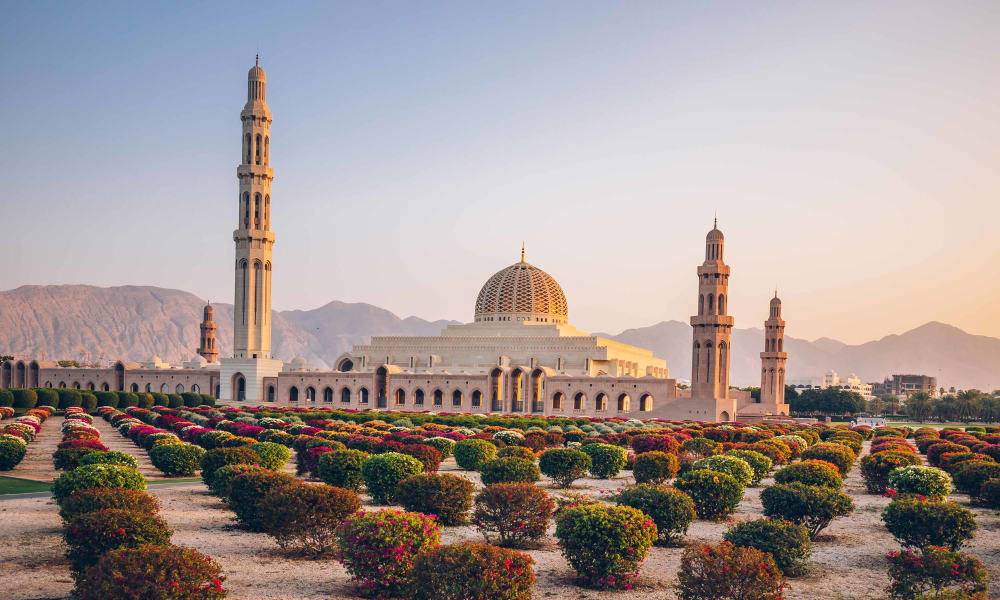
Sultan Qaboos
Sultan Qaboos

Sultan Qaboos ibn Said al Said ruled from July 23, 1970, until his death on January 10, 2020, in Oman. His successor is his cousin Haitham ibn Tariq. As an absolute ruler, the Sultan is the chairman of a cabinet, holding the most important positions himself in this cabinet and appointing other ministers according to his will. There are no free elections for the people, no parliament with political or personnel powers, or other democratic institutions in Oman. The Sultan unites the executive, judicial, and legislative branches in himself. Qaboos held absolute power in his sultanate, which is comparable in size to Germany and possesses a significant share of the world's oil reserves. Qaboos ibn Said al Said ruled for a total of five decades and transformed Oman into a very progressive state in the Arab world.
Before his term
Born on November 18, 1940, Qaboos grew up in the south of Oman. At 16, he was sent to England to attend a private school, which later reflected in his modern thinking regarding Oman. It was there that he first came into contact with the Western world. He took as much information, knowledge, and experience as possible. By then, Qaboos was already anchored in the consciousness of the cultural and historical responsibility he bore as the eighth descendant of the Al-Bu-Said dynasty, founded in 1744 by Imam Ahmed ibn Said. His ancestor was the one who ended the long and bloody civil war that had prevailed in the country up to that point and united Oman. Qaboos served as a cadet of the military academy in the British Army at Sandhurst, studied administration, and took a three-month journey around the world. Even at that time, Qaboos was very open-minded and became Sultan of Oman in 1970.
Qaboos' goals
Even in his inaugural speech, the then 30-year-old Sultan promised his people to lead them economically , culturally, and in the field of education into a new era. He succeeded in this. A functioning education system , a moderate interpretation of Islam, and a functioning government under the absolute leadership of the Sultan, as well as a flourishing economy and a people blessed with a certain wealth who know how to preserve the traditions of their ancestors without falling into extremism, are today the results of his decades of work.
Discover Oman with experts who have called it their home
Your dream holiday, tailor-made by experts.
We don't just know Oman from books, we visit the country several times a year to experience the culture, landscape and people first-hand.
From your first enquiry to your return home, we are there for you personally - by phone, email or WhatsApp, whenever you need us. Our trips are as unique as you are: individually planned and provided with exclusive privileges and high-quality arrangements that will make your trip unforgettable.
Experts for your Oman trip


You might also like this

Oryxantelope
The Arabian oryx belongs to the subfamily of horse antelopes and is a distinct genus. Its natural habitat is traditionally found in semi-arid and arid landscapes, such as the Arabian Peninsula. Thus, Oman is also part of its natural habitat. In places where the sun shines year-round and it often exceeds 30 degrees even in winter, the Arabian oryx is native. Characteristic of both sexes are its very light, almost white coat and its spiral, slightly curved horns. The shoulder or body height is about 80-100 cm, while the horn length usually measures 50-70 cm. Another feature is the dark brown an...

Oman in Ancient Times
Muslim Arabs, led by the companion of the Prophet Amr ibn al-As, conquered the region of Oman around 630 AD and made it part of the Caliphate of the Umayyads and Abbasids. They ruled Oman for an extended period from Baghdad and Damascus. This marks the dawn of Islam in Oman. Just a few decades later, the Islamic sect of Ibadism emerged, establishing independent Imamate in the interior around 900 AD. After prolonged power struggles, the authority of the Imams lost influence to the Nabhani dynasty, which managed to reunite Oman around 1180 AD. The Nabhani made Bahla their capital, but were cons...

Women in Oman
Between Tradition and Modernity Oman – a country where fascinating traditions meet modernity, set against breathtaking landscapes and a culture of warm hospitality that continues to attract more and more solo female travelers. For women who love exploring the world independently, Oman offers something unique: safety, freedom, and the opportunity to immerse yourself in the country’s cultural traditions. Here, you can travel solo with ease, experience authentic interactions with locals, and explore vibrant women’s markets where the local life thrives....